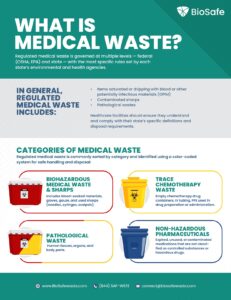
Correctly identifying medical waste is essential for protecting healthcare workers, patients, waste transporters, and the environment. Medical waste often contains bloodborne pathogens, hazardous pharmaceuticals, or cytotoxic residues, and improper classification increases the risk of exposure, injury, or contamination. OSHA’s Bloodborne Pathogens Standard requires that items contaminated with blood or potentially infectious materials—such as soaked dressings, gloves, and sharps—be handled as regulated waste. State environmental agencies also define regulated medical waste and set strict rules for how it must be segregated, labeled, and prepared for disposal.
Accurate categorization ensures that each waste type is placed into the correct container, such as red biohazard bins for infectious waste, FDA-approved sharps containers for needles and scalpels, or yellow chemotherapy containers for trace cytotoxic residue. This prevents dangerous mixing of incompatible waste streams and ensures that each material is treated through the appropriate disposal method, such as autoclaving, chemical disinfection, or incineration, as referenced in the guide (page 2).
Proper waste identification is also a transportation requirement. The U.S. Department of Transportation (DOT) regulates the movement of medical waste and requires manifests to track waste from the generator to the disposal facility (page 2).
Misclassification can lead to compliance violations, increased disposal costs, or environmental harm. By understanding what qualifies as biohazardous waste, pathological waste, non-hazardous pharmaceuticals, or trace chemotherapy waste (page 1), healthcare facilities ensure safer handling and adhere to both federal and state regulations.
For more information on the regulations regarding regulated medical waste, check out our free blog on medical waste compliance or check out the NC Department of Environmental Quality’s resource for medical waste.
What the “What Is Medical Waste?” Guide Includes
- Definition of regulated medical waste and its governing agencies
- General criteria for what qualifies as regulated medical waste
- Four major categories of medical waste:
- Biohazardous medical waste & sharps
- Pathological waste
- Trace chemotherapy waste
- Non-hazardous pharmaceuticals
- Color-coded container system for each category
- Approved destruction methods (incineration, autoclaving, chemical disinfection, microwaving)
- DOT requirements for transport and waste-tracking manifests
- Key steps to prevent improper disposal
- Contact information for compliance support
If you have more questions regarding medical waste, check out our FAQ page, our free blog covering various topics regarding medical waste or contact us using the form below.